Hey! Did you know that "little web thing" under your tongue has a purpose?
Well it does, and it is pretty darn important.

Your lingual frenulum connects your tongue to the base of your mouth. If your frenulum is too short, it can cause what the medical world calls ankyloglossia. We would call it "tongue tied"!
Ankyloglossia is congenital. There are some syndromes that exist where this is a common symptom. The frenulum can be part or completely fused to the base of the mouth causing ankyloglossia.
How do you look for this?
- I complete an oral motor examination on every student that comes through my doors.
- The easiest way I have found is to ask the student to stick their tongue out and imitate me.
- ask the student to reach tongue to the roof of their mouth, this should be difficult.
- ask them to stick their tongue out, you will notice the end of their tongue looks heart shaped and they will have trouble lifting tongue up to nose and down to their chin.
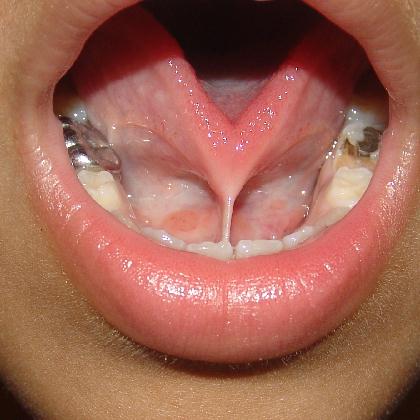
property of intelligent dental
- Difficulty breast feeding, the baby would have difficulty latching onto and maintaining suction of the breast. This may result in a fussy baby, weight loss, or chewing on nipple (instead of sucking)
- Some suggest anykloglossia may cause difficulty with speech sounds, specifically sounds made on the alveolar ridge /t, d, n, l/ and others involving careful placement of tongue tip /s, z, and r/.
- Although a relationship has been made by some, there is currently no evidence to back this up! Some students may speak perfectly fine with a short frenulum and others may have difficulty. They may also be two different things that occur together...confusing enough?
- Go with the evidence!!! Kummer, 2005, ASHA Leader Article
- Leave it alone! Unless it presents with a problem in infants with feeding, a personal annoyance or difficulty as an adult (can we say french kissing? ha ha).
- Frenulectomy- snipping of the frenulum by a doctor to allow more movement of the tongue. Hooray, it's free to move about! This is a short procedure usually and done while patient is awake. In more serious cases the patient is sedated.
- Although some believe that a frenulectomy is the "cure", it's not! In fact most of the time this surgery is not effective in fixing the student's articulation errors. So be wary what you suggest to parents! Best thing to do is treat the articulation and try different tongue placements the student can actually do successfully.
This picture is just too funny, I bet our students feel like this sometimes!

Property of Mr. Fibble
NOTE:Opinions are my own and not the views of my employer, some information summarized, including evidence regarding treatment was obtained from Kummer, 2005, ASHA Leader Article
share this on » |
{Facebook} |
{Twitter} |
{Pinterest} |